Honda NSX reborn as £770,000 JAS Tensei restomod
JAS Motorsport's Honda NSX Tensei pairs a Judd V6 with carbon bodywork and a manual gearbox, from £770,000 before VAT and the donor car; just 35 are planned.
 By Priya Malhotra · 5 min read
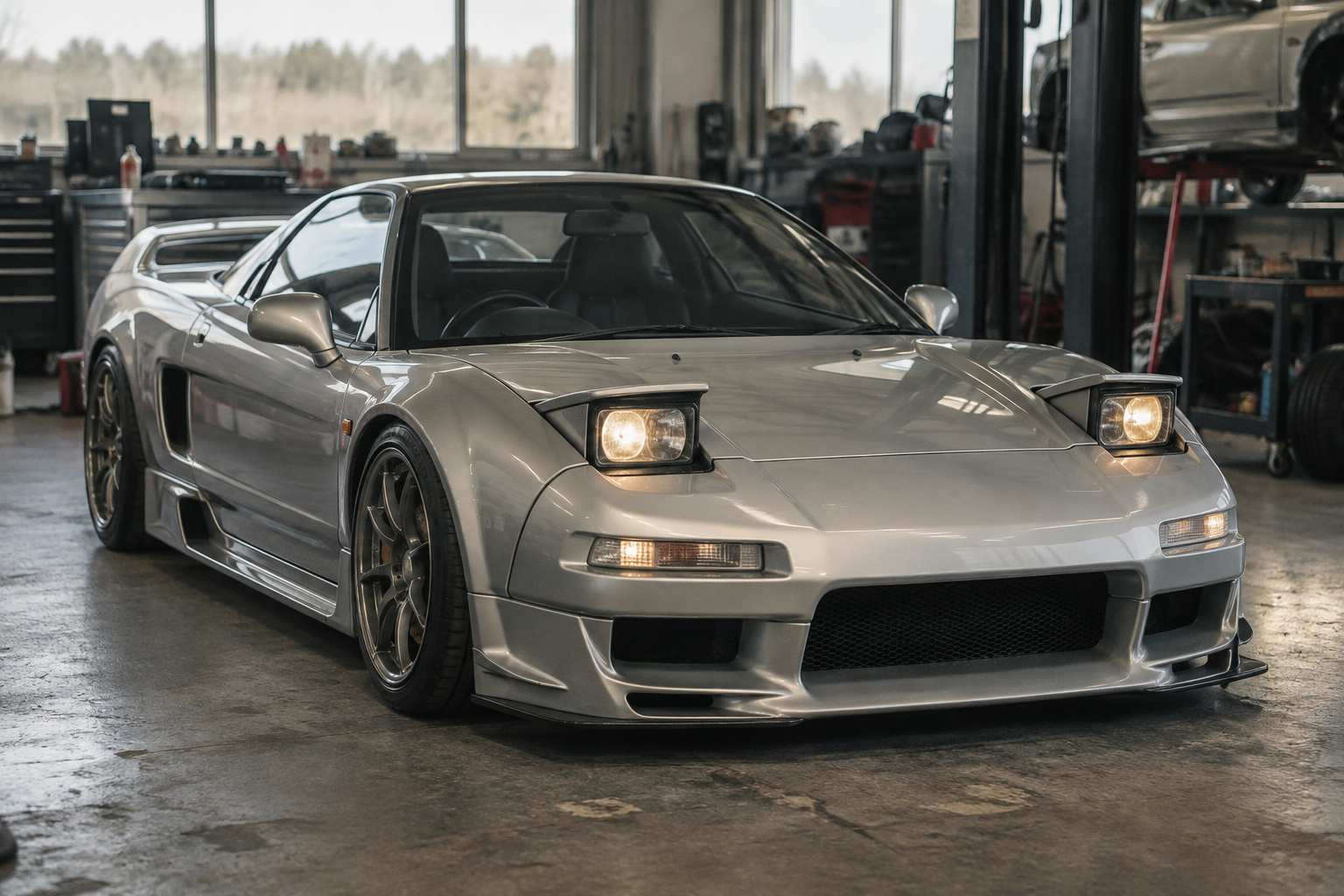
JAS Motorsport has completed the Tensei, its independent reworking of the first-generation Honda NSX, with a public debut planned for the 2026 Paris Motor Show, according to Motor1. Just 35 are planned, and Top Gear reports a starting price of £770,000 before VAT and the donor car. This is rather more than a nostalgic respray.
What JAS has changed on the Tensei NSX
The transformation begins with the donor's aluminium body panels, which make way for high-modulus carbon fibre shaped by Pininfarina. The Tensei is wider and longer than the original NSX, while Motor1 reports a flat underfloor and active rear diffuser. That makes this a substantial aerodynamic redevelopment, rather than an exercise in attaching expensive black weave to familiar surfaces.
Underneath, Top Gear reports reinforcement around the A- and B-pillars and central tunnel, revised suspension geometry and adjustable KW dampers. Brembo carbon-ceramic brakes provide the stopping hardware, with six-piston front and four-piston rear calipers. Electric power steering is another addition; its calibration will matter rather more than how reassuringly analogue the brochure makes it sound.
British engine specialist Judd Power retains Honda's C30A block but fits a new crankshaft, lightweight alloy cylinder heads and titanium valves. Both reports give the finished V6's output as 414bhp in their detailed specifications. Motor1 places peak power at 8,300rpm and torque at 305lb ft at 5,500rpm, with an 8,500rpm redline. This engine clearly expects its owner to participate.
The contentious alteration is the removal of VTEC, Honda's variable valve timing and lift system. Judd substitutes a fixed-timing racing valvetrain, while individual throttle bodies handle the intake side. Keeping the original block therefore does not mean preserving the original engine's character: some of the NSX's best-known engineering has deliberately been replaced.
Drive still goes exclusively to the rear wheels, through a six-speed manual gearbox. Motor1 specifies a carbon twin-disc clutch and Torsen limited-slip differential. The clutch's behaviour in traffic will be an important detail for prospective owners; a list of competition-flavoured components cannot establish whether a car is agreeable outside a pit lane.
There is also dry-sump lubrication, including a scavenge pump, and Top Gear says the engine sits 45mm lower. Lowering a substantial mass is useful chassis work, although the resulting balance cannot be assessed from mounting dimensions alone. It is one of the less visible changes, and potentially one of the more meaningful ones.
Inside, the specification includes a single-piece carbon-fibre dashboard, carbon-fibre Sabelt seats, leather, black Alcantara and OLED displays. That is a decisive departure from the original cabin's materials. Buyers wanting an untouched period interior should probably stop here, before anybody reaches for their cheque book.
The Honda NSX history behind Pininfarina's redesign
Pininfarina's connection predates the production NSX. Its Honda HP-X concept appeared at the 1984 Turin Motor Show, establishing an early link between the Italian design house and Honda's mid-engined ambitions. The Tensei renews that relationship, but the HP-X connection should not be confused with a claim that Pininfarina designed the production first-generation NSX.
The NSX itself made its public debut at the 1989 Chicago Auto Show and went on sale in 1990. Its aluminium monocoque construction helped distinguish it from contemporary sports cars. Just as importantly, Honda demonstrated that mid-engined performance need not require an owner to accept awkward ergonomics and temperamental everyday manners as signs of breeding.
Ayrton Senna contributed to the NSX's chassis development, but its significance extends beyond a famous test driver. The original combined a naturally aspirated V6 with unusually approachable road-car packaging. That balance explains why replacing hardware is only half the Tensei's challenge: the quality worth preserving is how the components work together, not simply their individual specifications.
Nor is a six-speed manual entirely new territory for the model. Honda introduced a 3.2-litre engine and six-speed manual in the 1997 update, while the earlier C30A was a 3.0-litre unit. The Tensei consequently combines an early engine-block lineage with a transmission format already familiar from later first-generation NSXs.
There is an important ownership distinction from Land Rover's Works V8 conversions for Defender owners: that programme comes from the vehicle manufacturer. JAS has a longstanding relationship with Honda, but Motor1 says Honda is not directly involved in the Tensei. Buyers are commissioning an independent conversion, not ordering a newly sanctioned Honda production model.
What JAS and Pininfarina say about the Tensei
According to Motor1, JAS wants the Tensei to compete in the modern supercar market while retaining the qualities associated with the original NSX. That is a more demanding brief than merely increasing power. Modern-supercar ambition and classic-car familiarity are not automatically compatible, especially when so much of the donor's hardware has changed.
Pininfarina's explanation of the design emphasises managing airflow without resorting to prominent additional wings. Top Gear reports internal airflow routes through the nose, wheel areas and engine intakes, alongside a reworked three-dimensional treatment for the rear lights. The intention is to make aerodynamic function part of the body rather than a collection of appendages bolted above it.
The pop-up headlights survive, but not as untouched Honda mechanisms. Their new specification includes servo-assisted operation, impact sensors and titanium components, according to Top Gear. It is a particularly revealing detail: preserving a familiar visual gesture has required an elaborate replacement system. Even the nostalgia has an engineering department.
Top Gear also reports a carbon-fibre intake plenum and Inconel exhaust intended to produce a soundtrack reminiscent of 1990s Grand Prix machinery. That is an appealing development target, not an independent acoustic verdict. Neither the material specification nor the engine's racing connections establishes exactly what an owner will hear from the driver's seat.
Tensei's Paris debut and the outstanding buyer questions
One figure needs careful handling before comparisons begin: the quoted weight is 1,250kg dry. It is not a ready-to-drive kerb weight. Setting it beside a rival's fuelled and fully equipped figure would make for a flattering comparison, but not a particularly useful one. A directly comparable running weight remains necessary.
There is also a discrepancy in the published engine capacity. Top Gear reports 3.4 litres; Motor1 reports 3.5 litres. Both describe an enlarged Honda-based V6, but the exact displacement needs confirmation from JAS rather than a journalist choosing whichever number looks tidier. A buyer's technical specification should settle that point explicitly.
The price requires similar discipline. Beyond the donor and tax exclusions reported by Top Gear, Motor1 says customisation costs extra. The advertised entry figure is therefore not the completed ownership budget. Donor assessment, the agreed scope of work and a written options schedule belong near the beginning of the conversation, not after the colour samples arrive.
For market perspective, the £35,000 Crayford Mini Mojito beach car demonstrates how widely restomod briefs and budgets vary. Meanwhile, Lunaz's sold-out US Range Rover Classic allocation provides a concrete example of demand for specialist conversions. Neither establishes demand for this NSX: 35 planned cars is a production limit, not evidence of 35 purchases.
The Paris appearance should give prospective customers their first public opportunity to inspect the finished car. Motor1 reports no wider rollout or dealer network alongside the announcement, and neither account supplies customer delivery dates. Before placing a deposit, buyers should establish the build slot, servicing arrangements, warranty terms and responsibility for future replacement parts.
Timeline
- 1984Pininfarina's Honda HP-X concept appears at the Turin Motor Show.
- 1989The Honda NSX makes its public debut at the Chicago Auto Show.
- 1990The production Honda NSX goes on sale with aluminium monocoque construction and a naturally aspirated V6.
- 1997Honda introduces a 3.2-litre engine and six-speed manual gearbox in the updated NSX.
- 2026The finished JAS Tensei is scheduled to make its public debut at the Paris Motor Show, according to Motor1.
Why this matters
For NSX owners, the important distinction is between improving a usable classic and commissioning a different sort of collectible. The Tensei keeps the donor's engine-block lineage and manual involvement, but replaces enough material and hardware to make originality a separate conversation. Its 35-car limit and £770,000 starting price place it in bespoke territory, not the ordinary NSX market. Buyers should judge provenance, build documentation and aftercare alongside the engineering: the donor's Honda identity does not answer every question about an independent conversion.
Your questions answered
- what is the JAS Tensei
- The Tensei is JAS Motorsport's independent restomod of the first-generation Honda NSX. It combines Pininfarina-designed carbon-fibre bodywork, a Judd-developed naturally aspirated V6 and a six-speed manual gearbox.
- how much does the JAS Tensei cost in the UK
- Top Gear reports a starting price of £770,000 before VAT and the donor NSX. Motor1 says customisation also costs extra, so the headline figure is not the final bill.
- how many JAS Tensei cars will be built
- JAS plans 35 cars, each based on a donor NSX. That is the announced production limit, not a confirmed sales total.
- how much power does the JAS Tensei have
- The detailed specifications in both reports give 414bhp. Motor1 places peak power at 8,300rpm, with 305lb ft of torque at 5,500rpm and an 8,500rpm redline.
- does the JAS Tensei still have VTEC
- No. Judd retains Honda's C30A block but replaces VTEC with a fixed-timing racing valvetrain. The engine also receives individual throttle bodies, new cylinder heads and titanium valves.
- is the JAS Tensei made by Honda
- No. It is an independent JAS Motorsport project involving Pininfarina and Judd Power. Motor1 reports that Honda is not directly involved, despite JAS's longstanding relationship with the manufacturer.
- when will the JAS Tensei make its public debut
- Motor1 reports a planned public debut at the 2026 Paris Motor Show. Customer delivery dates are not given in either report.
- how much does the JAS Tensei weigh
- The quoted figure is 1,250kg dry. That is not a ready-to-drive kerb weight, so comparisons with fully fuelled rivals need care.
Sources
This is original reporting drawing on facts first published by:
Features Writer, Heritage
Priya MalhotraMotoring historian with a soft spot for Le Mans in the Sixties and anyone who raced on a shoestring.