Land Rover opens Works V8 conversions to Defender owners
Land Rover Classic now offers a 405hp Works V8 conversion for eligible Defender 90 and 110 owners, plus chassis upgrades for earlier Puma-era models.
 By Callum Reid · 5 min read
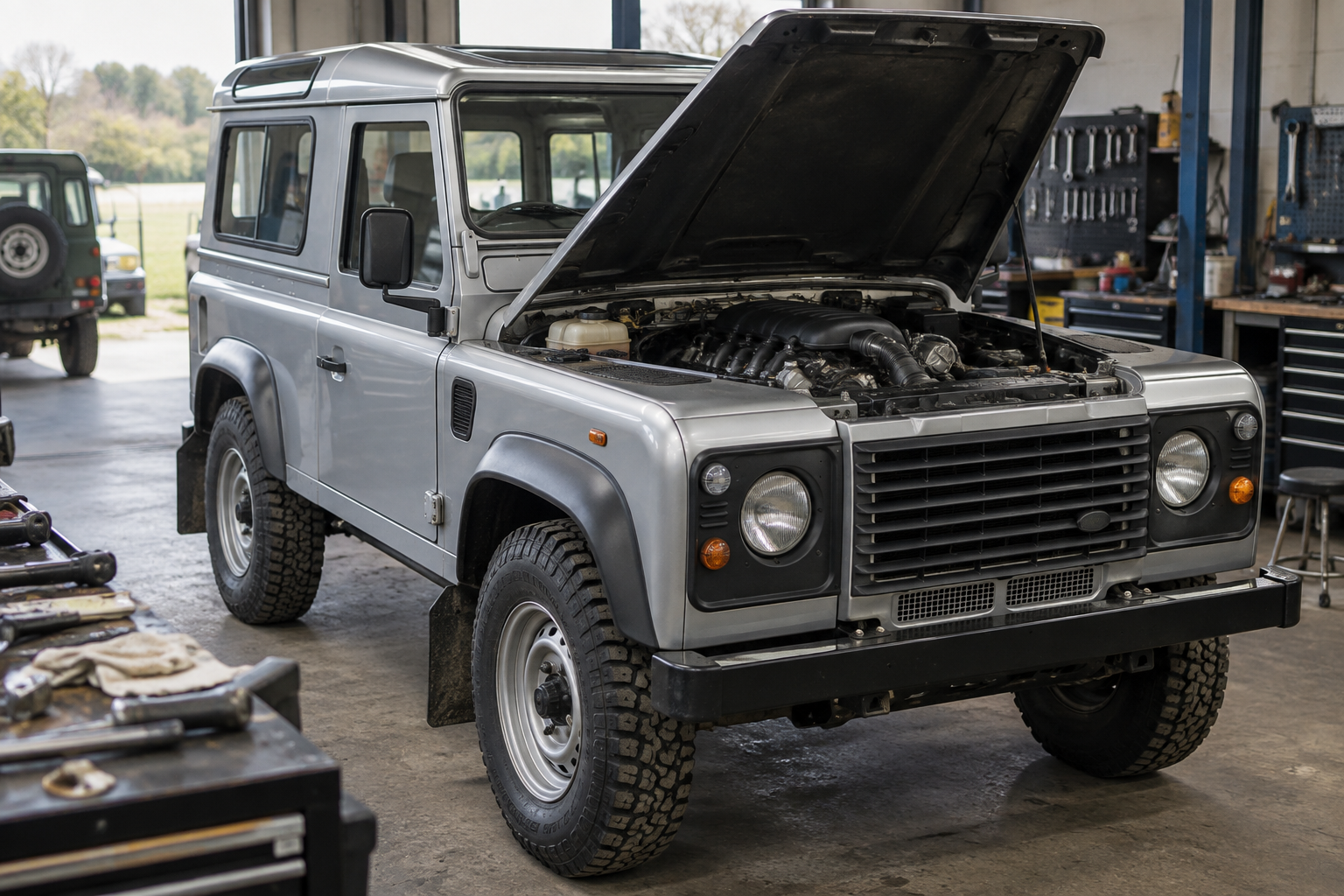
Land Rover Classic is now offering a Works V8 conversion for owners of late original Defenders, with specialist engine installations at its Classic Works facilities in the UK and Germany. The programme lets customers upgrade their own vehicles, rather than start again with a completed Works build.
What Land Rover's Defender Works V8 conversion includes
According to Motor1, the conversion replaces the Puma diesel with a naturally aspirated 5.0-litre petrol V8 producing 405hp and 380lb ft. An eight-speed ZF automatic handles transmission duties. This is a change of powertrain character as much as output: the diesel's working rhythm and manual gearchanges give way to something considerably less agricultural.
Eligibility needs careful reading. The engine conversion is restricted to L316-generation Defender 90 and 110 models from the 2012–2016 model years. The announced scope does not include the 130. Nor is this an engine option for the current-generation Defender; the recipient is the old, upright machine with the separate chassis.
The supporting suspension specification includes Bilstein dampers and Eibach coil springs. Gear Patrol also lists anti-roll bars, links and bushes among the changes. That matters because a power increase cannot, by itself, address how an older vehicle controls its body movements or how worn suspension components affect its responses.
Braking hardware comes from Alcon, with four-piston calipers and discs measuring 335mm at the front and 300mm at the rear. These are substantial departures from the standard Puma-era brakes. Anyone comparing conversion proposals should examine the stopping equipment alongside the engine specification, rather than treating it as an unglamorous footnote.
Inside, the work includes a redesigned transmission tunnel and gear selector, while Works V8 badging identifies the treatment outside. The automatic installation therefore reaches beyond the engine bay: it changes the cabin hardware through which the driver operates the vehicle, not simply the noise arriving through the bulkhead.
Wheel choices run from 16-inch steels to 18-inch alloys. That gives owners a useful visual choice between keeping the utility-vehicle appearance and making the upgrade more conspicuous. Steel wheels may be the quietest available way of announcing that your Defender now has 405hp.
How the Puma Defender fits Land Rover's V8 history
The family tree starts with the original Land Rover in 1948, although the Defender name arrived in 1990. The coil-sprung One Ten had appeared in 1983, followed by the Ninety in 1984. Those distinctions matter when shopping: a vehicle described casually as a classic Land Rover is not necessarily an eligible Defender.
The Puma period began in 2007, bringing a Ford-derived 2.4-litre diesel and six-speed manual gearbox, alongside a substantially revised dashboard. A 2.2-litre diesel followed for the 2012 model year. Consequently, the conversion's narrower eligibility window corresponds to the later diesel specification, rather than every vehicle carrying the familiar Puma-era bonnet bulge.
Original Defender production ended at Solihull in 2016. Its separate ladder chassis and live axles distinguish it fundamentally from the modern replacement. Upgrading springs, dampers and brakes works within that older architecture; it does not turn the vehicle into a contemporary Defender wearing a particularly convincing period costume.
Petrol V8s are hardly strangers to this lineage. The Stage One V8 arrived in 1979, using the Rover V8 before the coil-sprung models appeared. A large petrol engine in a traditional Land Rover therefore has historical precedent, even though this 5.0-litre conversion is emphatically not a recreation of that earlier installation.
Land Rover Classic launched the Defender Works V8 in 2018, marking the marque's 70th anniversary. The present programme extends that established idea to eligible customer vehicles. Its naturally aspirated engine also provides a technical distinction from V8s in today's production Defender range, which use forced induction.
Elsewhere, heritage is heading towards a charging socket: the proposed Citroën 2CV electric revival targets a price below €15,000. That is a different proposition from modifying an existing Defender. Buyers browsing the revival market need to distinguish replacement vehicles, reconstructed classics and upgrades to something already in their garage.
What JLR Classic and commentators say about the upgrades
Dominic Elms, director of JLR Classic, explicitly includes working vehicles in the intended audience. Motor1 reports his description of uses ranging from family transport to “a valuable collector's piece”. The pitch therefore reaches beyond occasional show appearances, although an owner's intended use should still determine which changes make practical sense.
The wider cosmetic and dynamic packages cover Defender 90 and 110 models from 2007–2016, Gear Patrol reports. Those packages can be selected separately from the engine conversion. An earlier Puma owner can therefore retain the diesel and pursue chassis improvements without discovering that the only available menu begins with eight cylinders.
Motor1 argues that installation through Classic Works offers useful documentation for insurers and subsequent buyers. That is an argument about traceability, not proof of increased resale value. Neither supplied report provides transaction evidence showing that the conversion adds its cost to a Defender's market price, and factory-backed modification is still modification.
Collector context matters here. The 1970 Lamborghini Miura P400S heading to Bonhams Zoute and UK-supplied Lamborghini Diablo SE30 bound for auction concern established period models. A converted Defender introduces another layer of specification: what Land Rover originally built and what its Classic division subsequently changed. Buyers should keep those identities separate when examining provenance.
How owners can arrange a Defender Works V8 assessment
Pricing has not been announced in the supplied reporting. Land Rover says final eligibility, specification and cost depend on the vehicle's condition, existing specification and market, with confirmation following specialist assessment. There is consequently no supported universal conversion price to place beside the purchase price of a tempting donor vehicle.
Installation routes differ according to the work. Cosmetic and dynamic components can be ordered through the Land Rover Classic Parts website for self-fitment, or installed through an authorised retailer. The full V8 conversion is directed to Classic Works in the UK and Germany; the parts-ordering option should not be mistaken for a driveway engine-conversion kit.
There is no firm turnaround time in either report, and availability is not universal across markets. Before arranging transport, owners should obtain confirmation that their particular vehicle can be accepted, what the proposed work includes and when it could be scheduled. Eligibility by model year is the starting point, not a booked workshop slot.
For UK owners, changing engine number or capacity also means keeping DVLA registration details accurate, while the modification needs to be disclosed to the insurer. Ask what installation records and engine-identification paperwork will accompany the finished vehicle. Factory involvement does not remove the owner's administrative responsibilities, however impressive the invoice heading might look.
Finally, old Defenders remain susceptible to chassis and bulkhead corrosion. A powertrain assessment should not be confused with evidence that every structural repair is included in the quoted work. Ask for remedial repairs to be identified separately, particularly when buying a vehicle specifically for conversion: a healthy engine is no substitute for sound metal underneath it.
Timeline
- 1948The original Land Rover establishes the utility-vehicle lineage that eventually leads to the Defender.
- 1979The Stage One V8 gives the traditional Land Rover a Rover V8 petrol engine.
- 1990The Defender name joins the Land Rover range.
- 2007The Puma-era Defender arrives with a 2.4-litre diesel and six-speed manual gearbox.
- 2012The 2.2-litre diesel model year begins the eligibility window for the newly announced Works V8 conversion.
- 2016Original Defender production ends at Solihull.
- 2018Land Rover Classic launches the Defender Works V8 for the marque's 70th anniversary.
Why this matters
Owners can now explore a factory-backed V8 transformation without abandoning a Defender they already know, while separate chassis packages give earlier Puma models a less drastic route to improvement. For buyers, the important distinction is between documented modification and originality: one does not automatically deliver the other, or guarantee a financial return. Until individual quotations arrive, condition, eligibility and the full scope of work matter more than the headline horsepower. The sensible first purchase is a proper assessment, not a donor bought in excitement.
Your questions answered
- which defenders qualify for the works v8 conversion
- The conversion covers L316 Defender 90 and 110 models from the 2012–2016 model years. Acceptance still depends on specialist assessment of the vehicle, its condition, existing specification and market.
- how much power does the land rover defender works v8 have
- The naturally aspirated 5.0-litre petrol V8 produces 405hp and 380lb ft. It drives through an eight-speed ZF automatic, replacing the Puma diesel and manual gearbox.
- how much does the defender works v8 conversion cost
- No price has been announced in the supplied reports. Land Rover says cost depends on the individual vehicle, specification and market, so an assessment comes before a meaningful figure.
- can a 2007 defender get the land rover v8 conversion
- Not under the announced engine-conversion criteria, which start with the 2012 model year. A 2007 Defender 90 or 110 falls within the broader cosmetic and dynamic upgrade programme.
- where is the defender works v8 conversion fitted
- Land Rover directs full V8 conversions to its Classic Works facilities in the UK and Germany. Specialist technicians handle the engine work there.
- can i fit land rover classic defender upgrades myself
- Cosmetic and dynamic components can be ordered through the Land Rover Classic Parts website for self-fitment, with authorised-retailer installation another option. That route should not be confused with the full V8 conversion.
- what brakes does the defender works v8 conversion use
- The supporting brake specification uses Alcon hardware with four-piston calipers, 335mm front discs and 300mm rear discs. The extra engine output is not being left to the original brakes.
Sources
This is original reporting drawing on facts first published by:
News Editor
Callum ReidGlasgow-born newsroom veteran covering the laws, policy and industry moves that affect classic owners.